---
title: "Block Processing"
description: "Stateful streaming workflows with carried filter state."
---
The `OctaveFilterBank`, `WeightingFilter` (for A, C, or Z-weighting) and
`TimeWeighting` classes support block (streaming) processing: the internal
filter state is carried between calls, so concatenated block outputs match a
single full-signal pass.
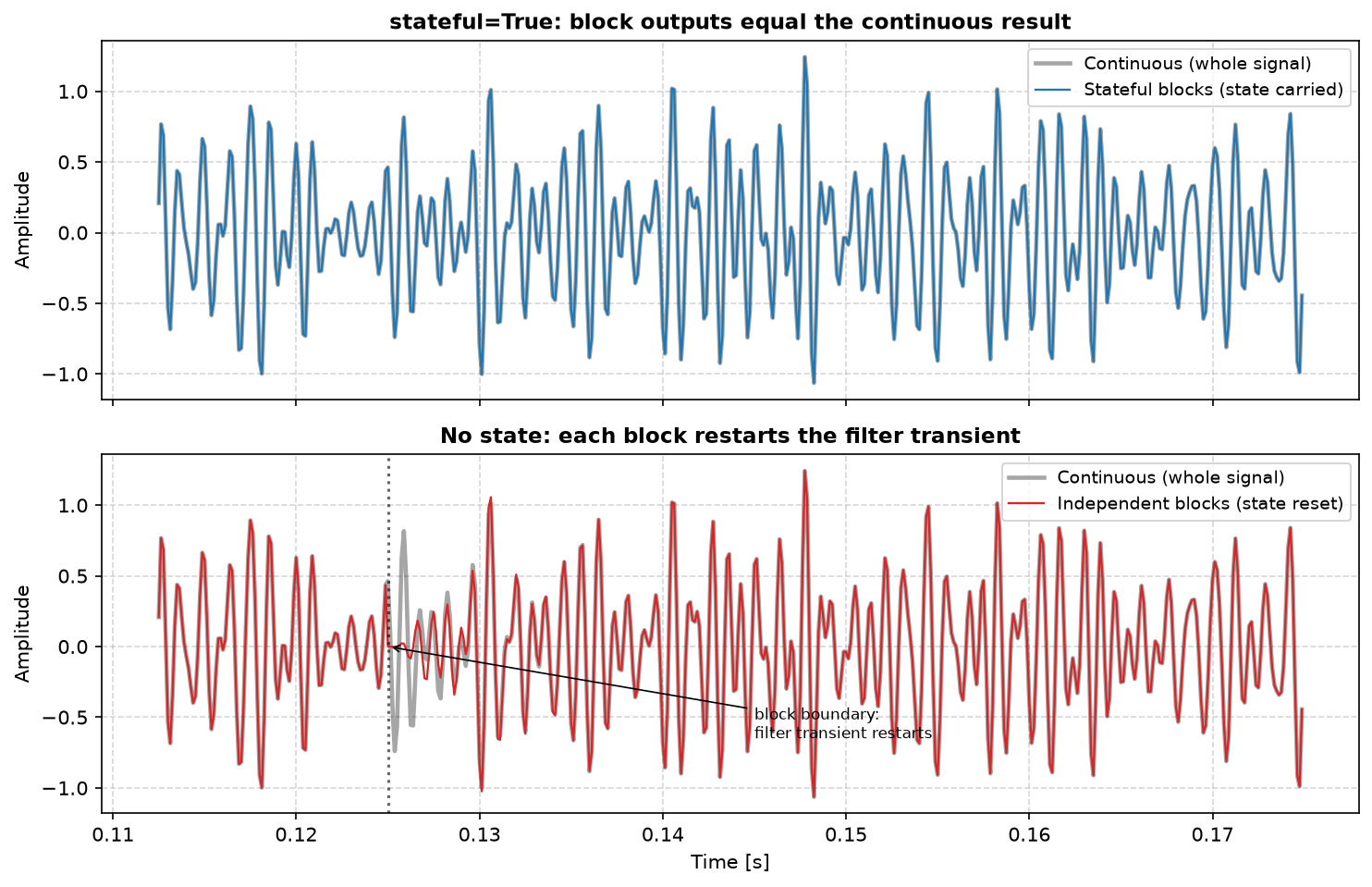
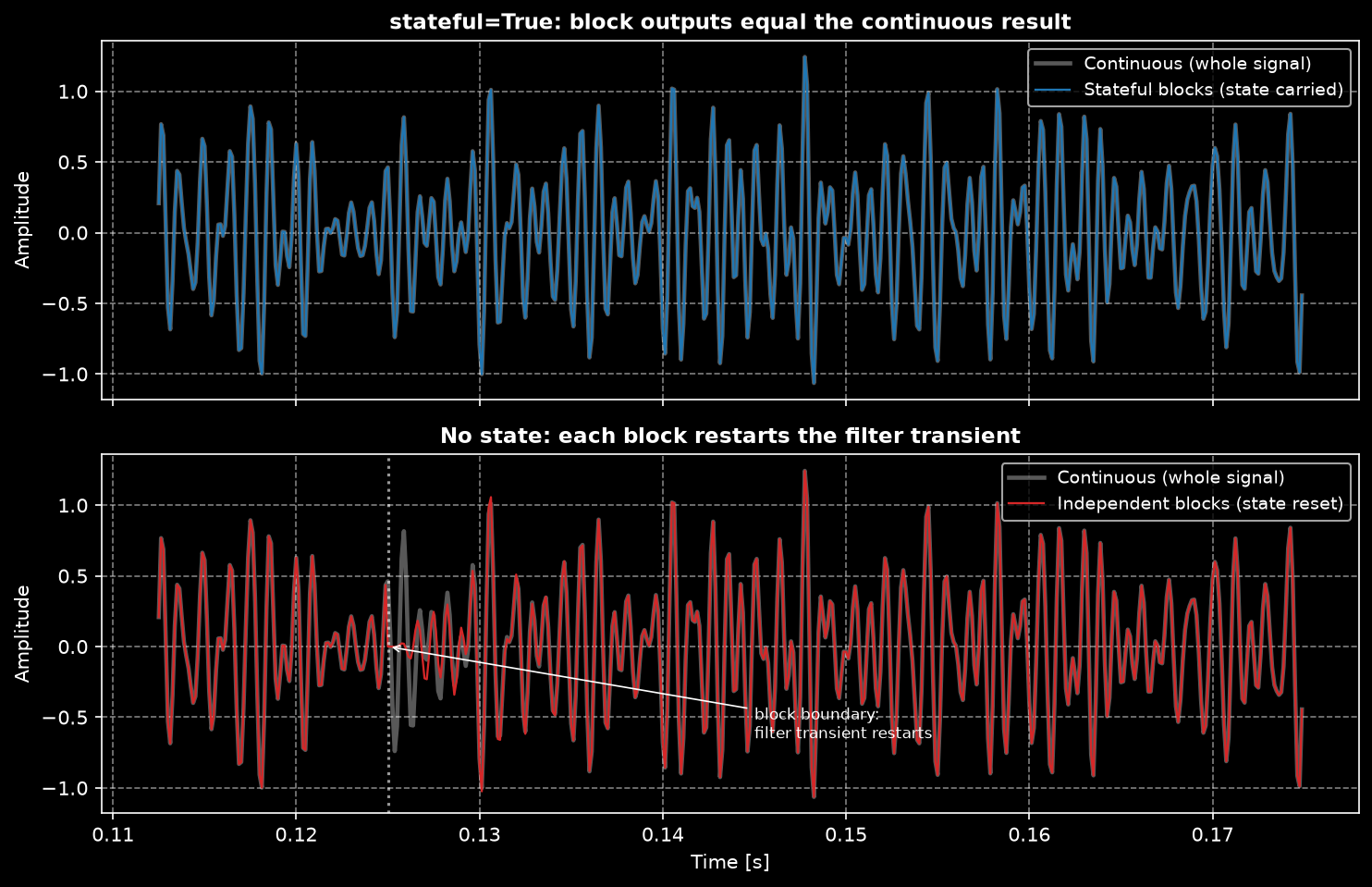 *With `stateful=True` the concatenated block outputs match the continuous
result exactly; without state, every block boundary restarts the filter
transient.*
Create a stateful filter bank with `stateful=True`. The internal state is
zero-initialized by default but may be initialized for step-response
steady-state (like `scipy.signal.sosfilt_zi`) with `steady_ic=True`.
Notes when using a stateful `OctaveFilterBank`:
- Detrending should be disabled during block processing (`detrend=False`), as it
can introduce discontinuities between blocks.
- Resampling is not supported for block processing, so you need to set
`resample=False`.
- `zero_phase=True` is incompatible with stateful mode (forward-backward
filtering needs the whole signal).
- Stateful `WeightingFilter` uses the legacy bilinear design
(`high_accuracy=False`); see [Frequency Weighting](/phonometry/guides/weighting/).
## Example
```python
import soundfile as sf
from phonometry import OctaveFilterBank, WeightingFilter
fs = 48000
octavefilter = OctaveFilterBank(fs, 1, stateful=True, resample=False)
afilter = WeightingFilter(fs, "A", stateful=True)
for block in sf.blocks("measurement.wav", blocksize=256, overlap=0):
# Apply A-filter
weighted = afilter.filter(block)
# Split into octave bands
block_spl, _, block_output = octavefilter.filter(weighted, sigbands=True, detrend=False)
# further signal processing
...
```
## Time weighting across blocks
Use the `TimeWeighting` class (state carried automatically):
```python
from phonometry import TimeWeighting
tw = TimeWeighting(fs, mode="fast")
for block in audio_blocks:
envelope = tw.process(block)
```
Or manage the state yourself with the functional API — see
[Time Weighting](/phonometry/guides/time-weighting/#block-processing).
## Multichannel state
All stateful classes handle multichannel input `(channels, samples)`: the state
is allocated lazily on the first call to match the channel count, and reallocated
if the channel count changes (e.g. switching from stereo to mono resets the state).
## Real-time level meter pattern
The canonical streaming loop — weight, envelope and report block by block
with all state carried across calls:
```python
import numpy as np
from phonometry import TimeWeighting, WeightingFilter
fs, block = 48000, 4800 # 100 ms blocks
aw = WeightingFilter(fs, "A", stateful=True)
env = TimeWeighting(fs, mode="fast") # the class is inherently stateful
for x in audio_stream(block): # your capture callback
y = env.process(aw.filter(x))
spl = 10 * np.log10(y[..., -1] / (2e-5) ** 2) # instantaneous LAF
display(spl)
```
### Stateful-mode constraints
| Option | Stateful behavior | Why |
| :--- | :--- | :--- |
| `detrend` | must be `False` | Per-block detrending creates boundary discontinuities |
| `resample` | must be `False` | The resampler is not stateful |
| `zero_phase` | unsupported | Forward-backward filtering needs the whole signal |
| `high_accuracy` (weighting) | resolves to `False` by default; explicitly passing `True` raises `ValueError` | The polyphase resampling inside is block-incompatible |
| `steady_ic` | optional | Starts the filters in step-response steady state |